Poznań Art Week 2026
May 15–30, 2026
Has the world become a “non-place”? A space in which rootedness is increasingly difficult, and shared, stable meanings even more so? A reality where concepts and values do not so much disappear as constantly shift their form, as if they have lost the right to any final definition?
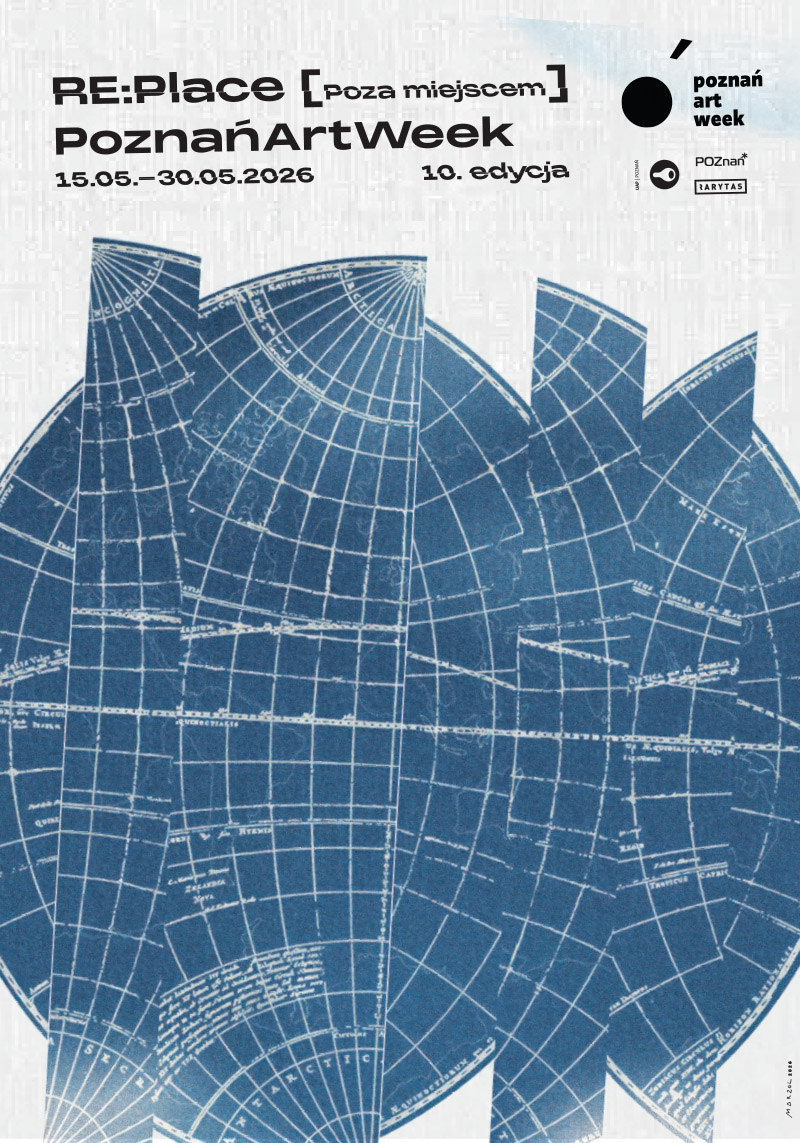
The title of this year’s edition — RE:Place – Out of Place — grows out of the logic of the projects that form the core of the program, while at the same time opening up a much broader field of reflection. It concerns not only art, but also the conditions in which we operate today: economic tensions that loosen former models of stability; social displacements that redefine community; political shifts in which borders—both real and symbolic—become increasingly fluid; and cultural transformations that cause identity to cease being a fixed point of reference and instead become a process.
This is a world in a state of vibration. Not spectacular, but constant, subterranean—one that changes the way we see, move, and remember.
This condition resonates in this year’s exhibitions.
In “Words of Truth,” where works by Zbigniew Libera and Paweł Napierała meet, the everyday collides with the imagined and the non-obvious. Images and objects operate through tension between what is familiar and what eludes recognition—building a language that does not so much describe reality as test its limits.
“Paradise” by Jerzy Hejnowicz, in turn, is a story of constant movement—the figure of a wanderer who never reaches a final point of rest. It presents a vision of the world as a process of migration, in which “place” becomes a temporary configuration rather than a stable structure.
The program also includes a graphic impression presented in an unexpected, perception-expanding format—approaching the image not as a closed form, but as a field of flow, trace, and transformation.
A special place is given to reflection on the cultural heritage of Central and Eastern Europe—a space that has long resisted simple geographical and symbolic definitions. The question of the meaning of post-Soviet experience returns here not as a historical label, but as an attempt to understand a specific articulation of postcolonial experience—one that does not resolve into a single narrative, but unfolds across multiple parallel histories.
This perspective also develops in the exhibition “La Villa,” presented in Villa Farsetti in Venice—a site that itself constitutes a gesture toward the history of exhibition spaces. A former residence, now reopening to art, becomes not only a backdrop but an active participant in the question of what “place” means for both artwork and viewer.
All these threads converge in a single question—one that resists any quick answer:
In the world — meaning where?
Curator of Poznań Art Week 2026
Mateusz M. Bieczyński
Texts
Mateusz M. Bieczyński
Festival’s Visual identity
Piotr Marzol
Website design
Tomasz Jurek
Organizers
Partners

Organizers


Supported by


Co-financed by the Minister of Culture and National Heritage as part of the program of the National Center for Culture: Culture – Interventions, edition 2023 and from the funds of the Poznań City Hall.
© Copyright by Poznań Art Week, Fundacja Rarytas 2026. All rights reserved.